This material is available in other languages:
ru
15 Jul 2026
Jailing the Same Person Twice: The Case Against Kabardino-Balkaria's Largest Property Developer
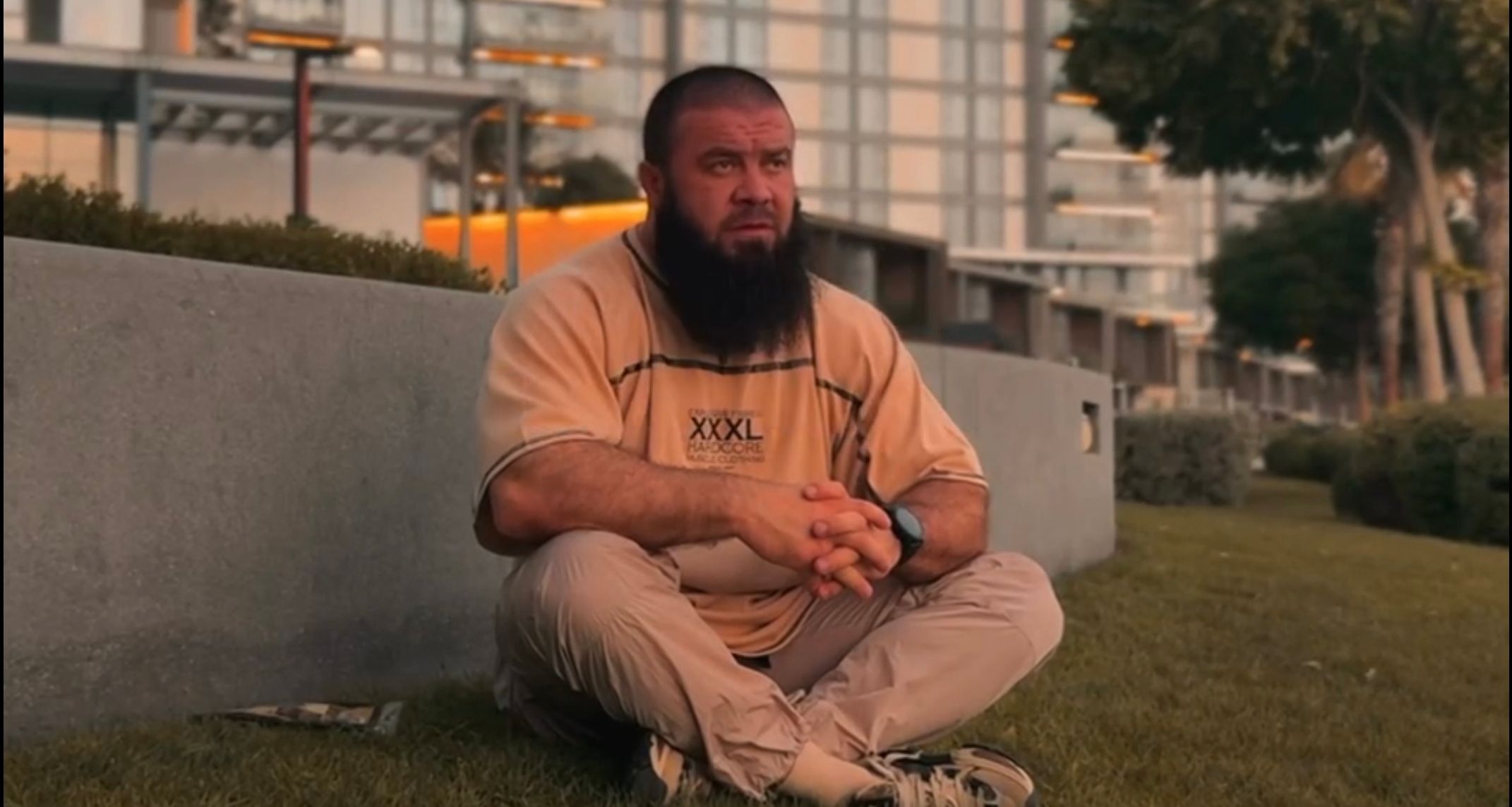
Андзор Халилов, фото: Кавказский узел
- Bankruptcy, Threats, and Deportation
- Raising Funds from Shared-Equity Investors
- “Financing Terrorism”
- Complaints
Andzor Khalilov, one of the largest property developers in Kabardino-Balkaria, a republic in Russia's North Caucasus, has come under pressure from law enforcement authorities.
It all began with a scandal stirred up by pro-government Telegram channels in the summer of 2024 over a school event. Khalilov’s wife, Asiyat, was among the parents of graduating students at a Nalchik school who did not stand during the Russian national anthem. Law enforcement officers drew up administrative offense reports against nine people, at least eight of whom were fined.
The developer later said that he had been threatened with criminal prosecution and subjected to extortion, while his offices were searched. In 2025, Andzor Khalilov was placed on a wanted list.
He is now being held in a pretrial detention center in Nalchik, facing two unrelated criminal cases at the same time. We explain what the businessman is accused of, how Khalilov himself explains the prosecution, and why his defense calls the case “legal absurdity.”
Bankruptcy, Threats, and Deportation
On July 11, 2025, the Arbitration Court of Kabardino-Balkaria accepted an application filed by the Federal Tax Service seeking to have Andzor Khalilov declared bankrupt. According to the tax authorities, the developer owed more than 3.6 million rubles to the state budget.
The Federal Tax Service attached to the application “information indicating that the debtor owns 616 items of property.” The following day, it emerged that Khalilov had been entered into the Interior Ministry’s wanted-person database in connection with an offense under the Criminal Code. On September 5, the Arbitration Court of Kabardino-Balkaria terminated the bankruptcy proceedings.
A year and a half earlier, Khalilov had travelled to the United Arab Emirates—for personal reasons, according to him. Some time later, his office in Nalchik was searched, and members of his family began to be summoned for questioning.
In August 2025, Khalilov published a statement in which he spoke of extortion by law enforcement officials. According to him, his family’s troubles began “with the anthem”:
“We did what the law required, and we apologized. I thought that was the end of it. But it turned out that everything was only beginning.”
On September 21, Khalilov said that he had been threatened with prosecution under the article concerning the illegal raising of funds from citizens for construction and that money had been demanded from him:
“First, 70 million [rubles], and then they added another 10 million... I did not have that kind of money to pay them. They said, ‘We’ll create problems for you.’”
This led to the suspension of several projects and jeopardized their completion deadlines.
At the end of December 2025, law enforcement officials announced that Andzor Khalilov had been deported from the UAE to Russia. The businessman was subsequently remanded in custody on charges of facilitating terrorist activity under Article 205.1 of the Criminal Code and raising funds from citizens in violation of the law on participation in shared-equity construction under Part 2 of Article 200.3 of the Criminal Code.
According to Khalilov, he was prepared to “be held accountable under the law” for a mistake made while running his construction business. However, money continued to be demanded from him, after which the terrorism-financing case emerged. The businessman categorically denies any guilt on the terrorism-related charge.
Raising Funds from Shared-Equity Investors
According to investigators, in 2023 and 2024, Khalilov and his accomplices misappropriated more than 21 million rubles from Nalchik residents through sham trust management agreements. The developer subsequently left Russia.
In September 2025, Khalilov appealed to the head of the republic, Kazbek Kokov, asking him to intervene and allow him to complete the residential buildings that remain unfinished.
The developer said that, should construction be completed, he would direct all profits from the sale of the properties toward supporting residents of the republic in need. The businessman also noted that, should his activities be getting in anyone’s way in the region, he was prepared to leave his homeland.
On May 2, 2026, it emerged that the case against Andzor Khalilov on charges of illegally raising money from citizens had been sent to the Nalchik City Court for trial separately from the terrorism-financing charge.
At the most recent hearing on the extension of his pretrial detention, he said that “no one is interested” in the evidence proving his innocence. The developer appeared at the hearing by video link from the detention center.
Andzor Khalilov
“It is in someone’s interest for me to remain here. Meanwhile, people cannot receive their apartments, and a thousand people are panicking because of this. If I were free, I would complete the construction more quickly. But no one is thinking either about the people or about justice.”
The state prosecutor said that, had Khalilov been concerned about the fate of the properties under construction, he would not have left for the UAE in 2025. Khalilov explained that he had travelled there for medical treatment and that construction had continued while he was away. According to the developer, work is still continuing, but it would progress more quickly were he free.
“Financing Terrorism”
The case against Khalilov is based on testimony from a protected witness identified by the surname Kardanov. He claims that Khalilov administered a WhatsApp group in which he “cited arguments from foreign scholars that every Muslim must, to the best of his ability, wage a struggle against the infidels.”
The witness allegedly met Khalilov at a mosque in Nalchik, where the businessman said that in 2018 he had met people from the North Caucasus republics in Saudi Arabia, including Artur Sabanchiev. Sabanchiev was collecting money for the needs of “brothers who are waging an armed struggle against government forces in Syria.”
Khalilov said that he did not know anyone named Kardanov and had never administered a WhatsApp group.
According to the indictment, in 2018 Khalilov transferred money on two occasions—a total of 25,000 rubles—to accounts belonging to Papuzhan Sabanchieva. The fundraising was conducted by her son Artur, who has lived abroad since 2010. On June 27, 2024, his details were added to Rosfinmonitoring’s register of terrorists and extremists, with a notation indicating his involvement in terrorism.
Khalilov maintains that the money he transferred to Sabanchiev’s mother’s bank card in 2018 was intended to pay for the treatment of Artur’s wife, who had been diagnosed with cancer. According to Khalilov, he may have made a financial contribution, as did “almost half the republic.” At the time, Sabanchiev was not on a wanted list and had not been included in the register of terrorists and extremists. On June 25, 2025, Andzor Khalilov himself was added to the register.
Investigators also allege that, during the same year, the businessman personally gave Sabanchiev 150,000 rubles in Saudi Arabia while performing the Hajj. Khalilov does not remember whether he gave him that amount. He says that he was giving zakat at the time and that the sums he gave were sometimes larger. The witness claimed that the cash was intended to support members of the banned organization Caucasus Emirate.
Khalilov published a recording made in the autumn of 2025 of a conversation with Artur Sabanchiev, during which Sabanchiev answers a third person’s questions about the circumstances surrounding the businessman’s criminal prosecution. In the recording, Sabanchiev says that, if the developer did transfer any money, it was intended for his wife’s treatment.
Sabanchiev then said that he had indeed met the businessman in Saudi Arabia when Khalilov travelled there for the Hajj in 2018, but that Khalilov had not given him any cash at the time.
Complaints
Andzor Khalilov told the court that he had twice been placed in a disciplinary isolation cell at the pretrial detention center for fabricated violations. Despite his back injury, he has not been given the medication brought to him by his relatives, while the detention center itself does not have the necessary medicines and is failing to provide medical assistance.
“This is simply abuse. Even during World War II, prisoners were treated better,” Khalilov said.
When the judge asked whether he had filed complaints with the prosecutor, Khalilov replied that he had submitted all his medical certificates and scans, but that they had already been under review for a second month: “Murderers here sit in cells with televisions and refrigerators and can call their relatives by phone or video link. I have done nothing but good for the republic, and yet this is how they treat me.”
At a hearing before the Supreme Court of Kabardino-Balkaria, Khalilov said that he “had not hidden or fled,” that he possessed all the evidence proving his innocence on the terrorism-related charge, and that he was prepared to take a polygraph test.
“I know of no other case like this in legal practice, jailing the same person twice. He is being held in connection with two separate cases; those cases have not been joined, and he is subject to two separate detention orders. This is some kind of legal absurdity,” Andzor Khalilov’s lawyer says.